
For owners, operators, and engineers managing lithium battery systems, a recurring question often arises: "Does a new battery pack truly require an additional balancing module?" While factory-matched cells are generally reliable at the start of their lifecycle, the long-term health and consistent performance of any series-connected pack depend heavily on maintaining precise voltage consistency. An Active Balancer serves as a high-efficiency, low-cost investment to safeguard this consistency throughout the operational life of the equipment. By utilizing real-world technical insights and engineering data from Heltec Energy (Chengdu Heltec Energy Technology Co., Ltd.) this article explores why active balancing technology is rapidly becoming an essential component for optimizing battery performance, system safety, and overall longevity in modern energy applications.
Q1: Why Do Lithium Battery Packs Experience Voltage Imbalance?
Every lithium battery pack, regardless of its initial assembly quality, is subject to the inevitable "battery barrel effect." This phenomenon occurs because no two individual cells are perfectly identical. Minor, inherent variations in internal chemical composition, manufacturing tolerances, specific self-discharge rates, and sensitivity to external thermal fluctuations are universal to both lithium-ion and lithium iron phosphate (LiFePO₄) cells.
As a battery pack undergoes repeated charge and discharge cycles, these microscopic differences accumulate and propagate. When a cell with a slightly higher capacity or lower internal resistance reaches its upper voltage limit faster than its neighbors, it can trigger premature charging cut-offs or protective shutdowns. Conversely, during discharge, the weakest cell may hit the low-voltage limit first. Over time, these imbalances widen. The weakest cell—the "shortest stave" in the barrel—effectively dictates and limits the usable capacity of the entire pack, forcing the system to cease operation even when the remaining cells still hold a significant amount of stored energy.
Q2: Is Passive Balancing Sufficient? Why Recommend an Active Balancer?
To mitigate these common issues, many traditional systems rely on passive balancing. This method typically utilizes resistors to dissipate the excess energy of high-voltage cells as heat until their voltage matches the rest of the group. While passive balancing is cost-effective, it is inherently limited: it only functions by draining energy, which does nothing to improve the total system capacity, and it generates unnecessary heat, which can be detrimental to battery health in high-temperature environments.
In contrast, an Active Balancer—such as the advanced modules engineered by Heltec Energy—employs sophisticated energy transfer techniques rather than dissipation. Utilizing high-performance super-capacitors or transformer push-pull rectification feedback, these devices actively move energy from cells with higher voltage to those with lower voltage. This method is significantly more efficient because it preserves valuable energy rather than wasting it. Advanced units, including those produced by Chengdu Heltec Energy Technology Co., Ltd., offer a comprehensive suite of features: they require no specific voltage difference to begin operation, function synchronously across the entire pack, and can deliver robust balancing currents ranging from 0 to 10A depending on the detected pressure differential. This technical capability allows for precise, real-time voltage correction, often achieving an accuracy within 0.01V.
Q3: How Does Installing an Active Balancer Module Improve Overall Pack Performance?
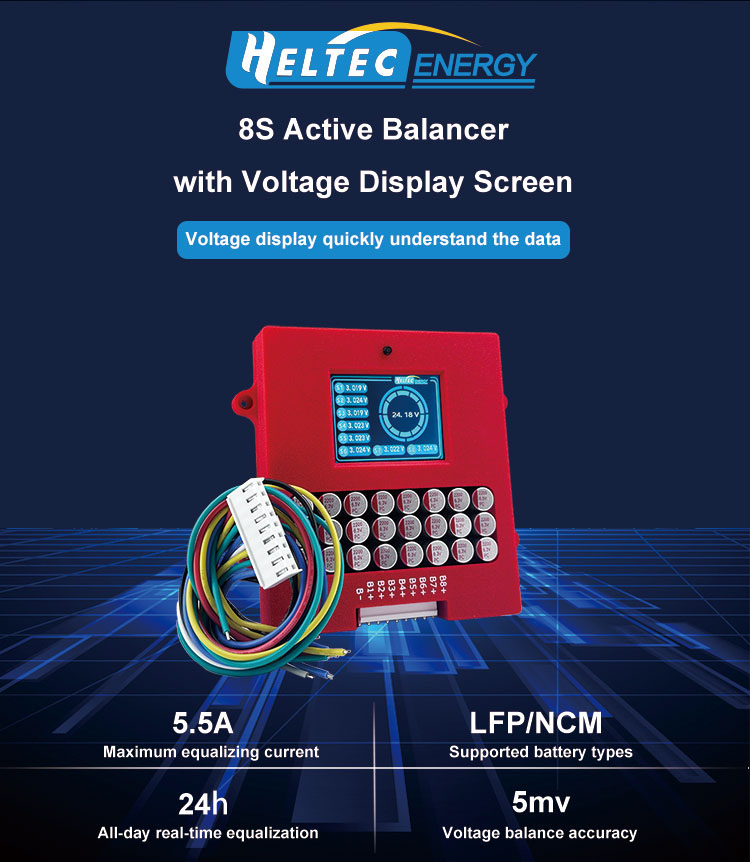
Integrating an active balancing module effectively transforms a battery pack from a collection of individual, potentially divergent cells into a cohesive, long-lasting energy system. The core benefit of the Heltec Energy 5A active balancer lies in its proactive ability to eliminate the bottlenecks caused by individual cell decay. By ensuring that every cell within an 8S to 32S configuration remains within a tight, optimized voltage range, the module allows the battery management system to utilize the full available capacity of the pack far more effectively.
This continuous maintenance process significantly extends the functional service life of the pack by preventing deep cycle stress on the weaker cells. Furthermore, these modules are designed for resilience in demanding industrial and mobile environments. Many units feature protective elements such as intelligent over-temperature protection, low-voltage sleep modes to prevent over-discharge during idle periods, and specialized three-proof coatings that provide critical insulation against moisture, dust, and corrosive elements. By maintaining consistent voltage levels, the stress on individual cells is minimized, leading to safer, more stable, and more reliable system operation across diverse applications, including electric vehicles, stationary energy storage systems, and industrial power supplies.
Q4: Under What Circumstances Is Installation Necessary or Deferrable?
Determining whether to install an active balancer often depends on the specific application, environmental stress, and usage profile of the battery system. For systems prone to significant operational stress, such as energy storage packs with 4S or higher series configurations, older battery packs where cells may have developed distinct degradation profiles, or setups that frequently operate with persistent voltage differentials exceeding 30mV, the installation is highly recommended. These scenarios benefit immediately from the stabilization and protection provided by the balancing module. Conversely, if a system utilizes a brand-new, perfectly matched cell pack and operates under very short, shallow charge-discharge cycles, immediate installation might not be strictly critical, though proactive monitoring remains highly advisable as the pack ages.
Conclusion
The stability of a lithium battery pack is fundamental to its long-term performance and financial viability. By addressing the root causes of cell imbalance through advanced energy transfer, the technology provided by Heltec Energy helps users maximize their investment, improve operational safety, and extend the functional life of their equipment. Whether maintaining a professional commercial fleet or an private energy storage system, proactive voltage management is a clear and effective path to achieving better battery health.
For those seeking to understand the specific balancing requirements of the unique battery setup or interested in detailed technical specifications for various cell configurations, more comprehensive resources and product information can be found at https://www.heltec-energy.com/
Post time: Aug-07-2026